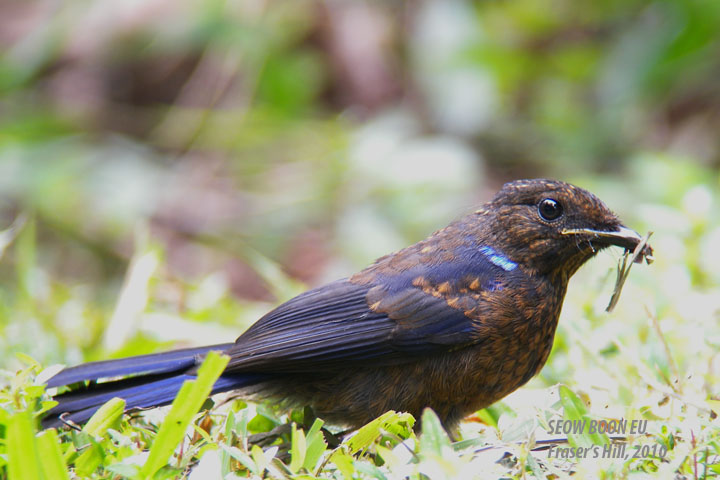
Showing posts with label Fraser's Hill. Show all posts

Friday, August 26, 2011

Red-headed Trogon in Fraser's Hill

(18 August, 2011) - I encountered two impressive species of Trogon during my trip to Fraser's Hill, the Orange-breasted and  Red-headed Trogon in Fraser's Hill. Due to the misty day, I only managed to digiscope the Red-headed Trogon.


Happy Birding.

Tuesday, August 23, 2011

Verditer Flycatcher's ...

(17 August, 2011) - Verditer Flycatcher (Eumyias thalassina) has a beautiful turquoise-blue plumage, which is easily distinguished from other bluish Niltava and Blue Flycatcher, it is also one of the common flycatchers in Fraser's Hill. Here is my digiscoped picture of Verditer Flycatcher in Fraser's Hill recently:

Verditer Flycatcher 

After digiscoped the flycatcher, I scanned around with my naked eyes for any bird on the tree and the ground, suddenly, something stunning on the grass reflected the sunlight like a gem with stunning colour, I then approached the item and confirmed it was a tiny feather, a beautiful turquoise-blue feather. 

I cannot surely confirmed this tiny turquoise-blue feather is the feather of Verditer Flycatcher, but logically it should be, because I found this turquoise-blue feather at the same spot where I saw the flycatcher.

Photographed on Craig Robson's field guide, plate-92, to show how small the feather.
Thus, birding is not necessary only watching or observing the birds, sometimes you can find something interesting on the ground where the birds have perched or roosted.

Happy Birding!

Monday, July 5, 2010

Silvery Birds of Fraser's Hill

Silver has long been valued as a precious metal, which is used to make ornaments, jewelry, currency coin and etc. Will the silvery plumage make the bird more valuable? definitely not, but silvery plumage on the bird can make them the elegant and unique birds. There are two species of birds in Fraser's Hill which have the silvery plumage, namely the Silver-eared Mesia (Leiothrix argentauris) and Silver-breasted Broadbill (Serilophus lunatus).

Silver-eared Mesia  is one of the common birds and also the icon bird of Fraser's Hill. It has silvery ear-coverts, yellow forehead, throat and breast, black head, greyish wing-coverts and scapulars, reddish wing-patch or tail coverts. They are social song birds that always follow the bird wave.

Front views (click on the picture for enlarged view)

side and top views

back and bottom view


Silver-breasted Broadbill  is one of the rare broadbills in Fraser's Hill, they are usually in pairs. This species of Broadbill has an elegant white necklace and silvery breast, black supercilium, black and blue wings, brownish rump, and black tail.

front view (male)

side views, female has less blue on wings and whitish necklace.

Silver-breasted Broadbill (female) consuming a small tarantula...

Hope you like these silvery birds of Fraser's Hill, do not miss them when you visit Fraser's Hill.

Click HERE to read my other blog postings about birding in Fraser's Hill.

Have a happy birding.

Saturday, July 3, 2010

Slaty-backed Forktail in Fraser's Hill

Slaty-backed Forktail (Enicurus schistaceus) is the only montane species of forktail in Peninsular Malaysia. I had been trying to digiscope this forktail since last year in Cameron Highlands, but it's a difficult task, because forktail usually won't stay still in one position, and its white feathers also further increase the difficulty for a camera to capture the image.

Adult Slaty-backed Forktail in Cameron Highlands

I was lucky to spot a Slaty-backed Forktail swallowing a small snake in Fraser's Hill. Due to the weight of the snake, the forktail couldn't move easily, it has to swallow at least three quarter of the snake before take off. Therefore, it's the best moment for me to digiscope the forktail in many views with minimum movement.

Let's take a closer look and have a good study of the bird:

front view

side views, right and left.

top and back view...  unfortunately, no bottom view.

I noticed that it has greyish flecks on the throat and breast, and whitout white on forehead. Whereas, most bird books describe the juvenile as brownish rather than black and grey. So, I believe this forktail could be an immature.

Hope you could gain some knowledge about this elegant bird from this blog posting. Click HERE to read my other postings about birding in Fraser's Hill.

Have a happy birding, digiscoping and digisniping.

Friday, June 25, 2010

Fraser's Hill International Bird Race 2010


Fraser's Hill is one of the best montane birding sites in Malaysia, it is also one of the Important Bird Areas (IBA) recognized by BirdLife International, click HERE to learn more about the IBA. You can also find out more about Fraser's Hill from these LINK1 LINK2.

I was in Fraser's Hill to volunteer as a marshall for the Fraser's Hill International Bird Race 2010 from 18th to 20th June. Click HERE for the event news reported by Malaysian Nature Society, MNS. Thanks to MNS Selangor Bird Group for inviting me to be part of the event.


I brought home two useful publications from this event, A checklist of the Birds of Peninsular Malaysia, published by MNS, priced RM25 per copy for MNS member. The front cover of the publication is a beautiful Himalayan Cutia. Himalayan Cutia is one of the birds which I wish to see in the wild.


Total number of bird species = 656
Total number of resident birds = 445
Total number of species occurring as migrants = 185
Total number of species occurring as vagrants = 58
Total number of species with both resident and migratory populations = 40
Total number of species considered extinct within Peninsular Malaysia = 8
Total number of regional endemics = 4
Total number of threatened species = 126


The second publication is Bird Watching in Malaysia, a free copy from Tourism Malaysia, which can be downloaded HERE.


After the bird race, I spent another three full days in Fraser's Hill for digiscoping together with Ooi Beng Yean. Thanks to Beng Yean for sharing some of his digiscoping tips. Follow the link are listed to view my digiscoped pictures of the wild birds of Fraser's Hill.

Click HERE to view the colorful common birds in Fraser's Hill.
Click HERE to view the fledgling of the Brown Wood Owl.
Click HERE to view the Slaty-backed Forktail.
Click HERE to view the Silvery Birds of Fraser's Hill. 


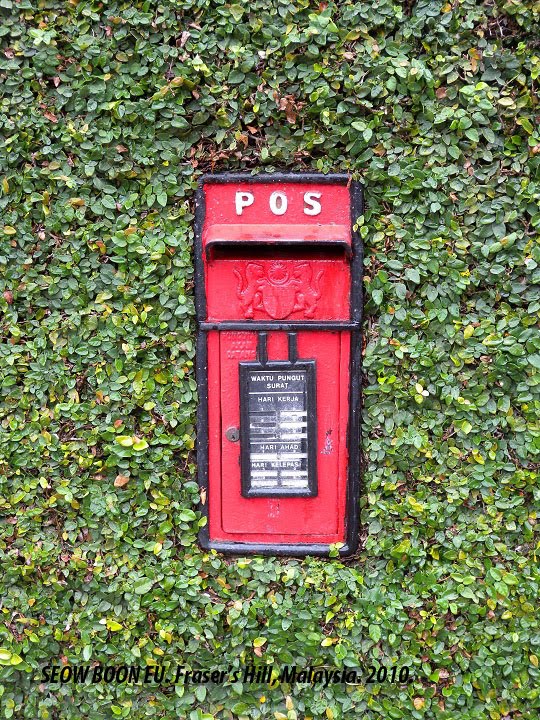
Besides birds, I'm also interested in the bird art on stamps, especially the Hornbills, Owls and Oriental Birds. Therefore, I intentionally visited the post office in Fraser's Hill to find some bird stamps. I saw an unique and beautiful post box outside the post office, which I would then like to share the picture of this beautiful post box in my blog. The post office is one of the post offices in Malaysia located at the BirdLife International recognized IBA.


post box in Fraser's Hill


Happy Birding, Digiscoping and Digisniping.

Brown Wood Owl

Spotted the Brown Wood Owl (~50cm) in my birding trip, both adult and fledgling. The fledgling has a cute and furry white head robe, so adorable isn't it?

The juvenile Brown Wood Owl

Adult Brown Wood Owl

The juvenile and the adult sitting side by side.


Click on the following links to view other owls which digiscoped recently:

A Gentle Reminder: Owl is currently threatened by illegal hunting, due to a recently-emerging taste of owl meat in Asia. Click HERE to read the news report.

Please stop killing and eating these adorable owls.  请停止杀害和食用这些可爱的猫头鹰.


Happy Owling

Birding in Fraser's Hill

After the bird race, I spent three full days for digiscoping in Fraser's Hill, from 21st to 23rd June. In fact, April to July are the best period for observing the resident birds. The common birds of Fraser's Hill are usually Passeridans and Corvidans.

The common Passeridans include the Silver-eared Mesia, Long-Tailed Sibia, Blue-winged Minla, Malayan Laughingthrush, Spectacled Laughingthrush, Streaked Spiderhunter, Black-headed Sunbird, Mountain Fulvetta, Mountain Bulbul and Large Niltava.

Silver-eared Mesia is one of the common birds, and it is also the icon bird of Fraser's Hill, with beautiful feather colors of red, yellow, silver, black and grey.

Silver-eared Mesia

Malayan Laughingthrush (a.k.a. Chestnut-crowned Laughingthrush), an endemic species of Peninsular Malaysia and Southern Thailand. Malayan Laughingthrush and Spectacled Laughingthrush (a.k.a. Chestnut-capped Laughingthrush) are the most common laughingthrushes in Fraser's Hill, whereas, the Black Laughingthrush is the less common.

Malayan Laughingthrush

Malayan Laughingthrush

Streaked Spiderhunter and Black-throated Sunbird are the most common nectarivores in Fraser's Hill.

Streaked Spiderhunter

Black-throated Sunbird

Long-Tailed Sibia and Blue-winged Minla are also common birds in Fraser's Hill, but Blue-winged Minlas is hard to digiscope, coz they usually move very fast like the warbler. Warbler-type of birds are the main challenge for a digiscoper, and I'm looking forward to digiscope a warbler, hopefully I can make it.

Long-Tailed Sibia

Blue-winged Minla

Mountain Bulbul and Ochraceous Bulbul are the most common bulbuls in Fraser's Hill, other bulbuls can occasionally be seen, which include the Black-crested Bulbul and Ashy Bulbul.


Mountain Bulbul

Ochraceous Bulbul

Black-crested Bulbul

Mountain Fulvetta is one of the fast moving birds, with the skill and patience, it can be digiscoped also.
Mountain Fulvetta

White-rumped Munia is the only munia species I spotted in Fraser's Hill.
White-rumped Munia

Rufous-browed and Little Pied Flycatchers are the common flycatchers in Fraser's Hill, but Rufous-browed Flycatcher is easy to digiscope than any other flycatchers in Fraser's Hill.
Rufous-browed Flycatcher, guess which is male, female and juvenile.

Large Niltava is one of the common birds in Fraser's Hill, you can easilly see it on every street or trail.
Adult Large Niltava, male in Blue and female in brown.

Juvenile Large Niltava

The common Corvidans in Fraser's Hill include the Grey-chined Minivet, Javan Cuckoo-Shrike, Lesser Racquet-tailed Drongo, Bronze Drongo, White-Throated Fantail, and Black & Crimson Oriole.

Grey-chined Minivet, male in orange color, and female in yellow.

Javan Cuckooshrike

Please be reminded, there is no Large Cuckooshrike recorded in Peninsular Malaysia. I realized that many have mistakenly named it as Large Cuckooshrike rather than Javan Cuckooshrike.

White-Throated Fantail

Lesser Racquet-tailed Drongo

Black and Crimson Oriole

Woodpeckers and Barbets are also highly vsible in Fraser's Hill, the most common Barbets are the Fire-tufted Barbet and Black-Browed Barbet.

Black-Browed Barbet

Fire-tufted Barbet

The most common Pigeons in Fraser's Hill are the Mountain Imperial Pigeon and the Little Cuckoo Dove. Other Green Pigeons can also be found in the forested area at the lower elevation.

Mountain Imperial Pigeon

Little Cuckoo Dove

Trogon, Broadbill and Pitta are not a common birds in Fraser's Hill, you may occasionally spot them in the forested area. Red-headed and Orange-breasted Trogon are the most visible trogon in Fraser's Hill, and I only spotted the Red-headed Trogon in this birding trip.

Red-headed Trogon

Long-tailed Broadbill and Silver-breasted Boardbill are the most visible broadbills in Fraser's Hill.
Long-tailed Broadbill

My lifers in this trip included the Long-tailed Broadbill, Black Laughingthrush, Ashy Bulbul and White-hooded Babbler.

Click HERE to find out more about birding in Fraser's Hill and Fraser's Hill International Bird Race.

Happy Birding, Digiscoping and Digisniping.