After the bird race, I spent three full days for digiscoping in Fraser's Hill, from 21st to 23rd June. In fact, April to July are the best period for observing the resident birds. The common birds of Fraser's Hill are usually Passeridans and Corvidans.
The common Passeridans include the Silver-eared Mesia, Long-Tailed Sibia, Blue-winged Minla, Malayan Laughingthrush, Spectacled Laughingthrush, Streaked Spiderhunter, Black-headed Sunbird, Mountain Fulvetta, Mountain Bulbul and Large Niltava.
Silver-eared Mesia is one of the common birds, and it is also the icon bird of Fraser's Hill, with beautiful feather colors of red, yellow, silver, black and grey.
Silver-eared Mesia
Malayan Laughingthrush (a.k.a. Chestnut-crowned Laughingthrush), an endemic species of Peninsular Malaysia and Southern Thailand. Malayan Laughingthrush and Spectacled Laughingthrush (a.k.a. Chestnut-capped Laughingthrush) are the most common laughingthrushes in Fraser's Hill, whereas, the Black Laughingthrush is the less common.
Malayan Laughingthrush
Malayan Laughingthrush
Streaked Spiderhunter and Black-throated Sunbird are the most common nectarivores in Fraser's Hill.
Streaked Spiderhunter
Black-throated Sunbird
Long-Tailed Sibia and Blue-winged Minla are also common birds in Fraser's Hill, but Blue-winged Minlas is hard to digiscope, coz they usually move very fast like the warbler. Warbler-type of birds are the main challenge for a digiscoper, and I'm looking forward to digiscope a warbler, hopefully I can make it.
Long-Tailed Sibia
Blue-winged Minla
Mountain Bulbul and Ochraceous Bulbul are the most common bulbuls in Fraser's Hill, other bulbuls can occasionally be seen, which include the Black-crested Bulbul and Ashy Bulbul.

Mountain Bulbul
Ochraceous Bulbul
Black-crested Bulbul
Mountain Fulvetta is one of the fast moving birds, with the skill and patience, it can be digiscoped also.
White-rumped Munia is the only munia species I spotted in Fraser's Hill.
White-rumped Munia
Rufous-browed and Little Pied Flycatchers are the common flycatchers in Fraser's Hill, but Rufous-browed Flycatcher is easy to digiscope than any other flycatchers in Fraser's Hill.
Rufous-browed Flycatcher, guess which is male, female and juvenile.
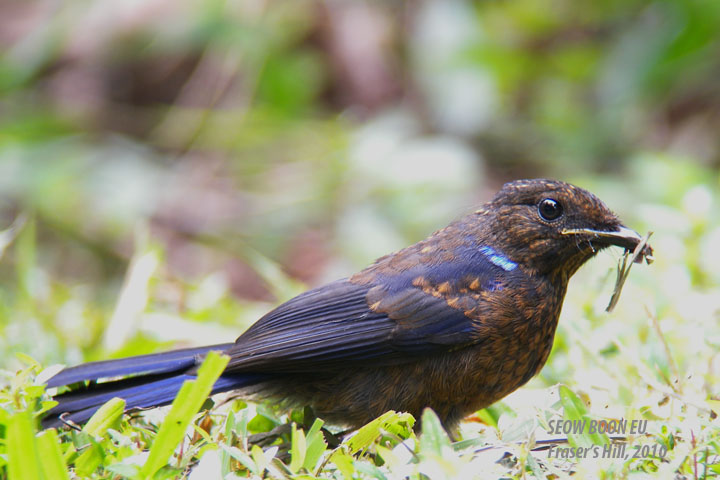
Large Niltava is one of the common birds in Fraser's Hill, you can easilly see it on every street or trail.
Adult Large Niltava, male in Blue and female in brown.
Juvenile Large Niltava
The common Corvidans in Fraser's Hill include the Grey-chined Minivet, Javan Cuckoo-Shrike, Lesser Racquet-tailed Drongo, Bronze Drongo, White-Throated Fantail, and Black & Crimson Oriole.
Grey-chined Minivet, male in orange color, and female in yellow.
Javan Cuckooshrike
Please be reminded, there is no Large Cuckooshrike recorded in Peninsular Malaysia. I realized that many have mistakenly named it as Large Cuckooshrike rather than Javan Cuckooshrike.
White-Throated Fantail
Lesser Racquet-tailed Drongo
Black and Crimson Oriole
Woodpeckers and Barbets are also highly vsible in Fraser's Hill, the most common Barbets are the Fire-tufted Barbet and Black-Browed Barbet.
Black-Browed Barbet
Fire-tufted Barbet
The most common Pigeons in Fraser's Hill are the Mountain Imperial Pigeon and the Little Cuckoo Dove. Other Green Pigeons can also be found in the forested area at the lower elevation.
Mountain Imperial Pigeon
Little Cuckoo Dove
Trogon, Broadbill and Pitta are not a common birds in Fraser's Hill, you may occasionally spot them in the forested area. Red-headed and Orange-breasted Trogon are the most visible trogon in Fraser's Hill, and I only spotted the Red-headed Trogon in this birding trip.
Long-tailed Broadbill and Silver-breasted Boardbill are the most visible broadbills in Fraser's Hill.
Long-tailed Broadbill
My lifers in this trip included the Long-tailed Broadbill, Black Laughingthrush, Ashy Bulbul and White-hooded Babbler.
Click
HERE to find out more about birding in Fraser's Hill and Fraser's Hill International Bird Race.
Happy Birding, Digiscoping and Digisniping.