Showing posts with label Dove. Show all posts

Friday, June 25, 2010

Birding in Fraser's Hill

After the bird race, I spent three full days for digiscoping in Fraser's Hill, from 21st to 23rd June. In fact, April to July are the best period for observing the resident birds. The common birds of Fraser's Hill are usually Passeridans and Corvidans.

The common Passeridans include the Silver-eared Mesia, Long-Tailed Sibia, Blue-winged Minla, Malayan Laughingthrush, Spectacled Laughingthrush, Streaked Spiderhunter, Black-headed Sunbird, Mountain Fulvetta, Mountain Bulbul and Large Niltava.

Silver-eared Mesia is one of the common birds, and it is also the icon bird of Fraser's Hill, with beautiful feather colors of red, yellow, silver, black and grey.

Silver-eared Mesia

Malayan Laughingthrush (a.k.a. Chestnut-crowned Laughingthrush), an endemic species of Peninsular Malaysia and Southern Thailand. Malayan Laughingthrush and Spectacled Laughingthrush (a.k.a. Chestnut-capped Laughingthrush) are the most common laughingthrushes in Fraser's Hill, whereas, the Black Laughingthrush is the less common.

Malayan Laughingthrush

Malayan Laughingthrush

Streaked Spiderhunter and Black-throated Sunbird are the most common nectarivores in Fraser's Hill.

Streaked Spiderhunter

Black-throated Sunbird

Long-Tailed Sibia and Blue-winged Minla are also common birds in Fraser's Hill, but Blue-winged Minlas is hard to digiscope, coz they usually move very fast like the warbler. Warbler-type of birds are the main challenge for a digiscoper, and I'm looking forward to digiscope a warbler, hopefully I can make it.

Long-Tailed Sibia

Blue-winged Minla

Mountain Bulbul and Ochraceous Bulbul are the most common bulbuls in Fraser's Hill, other bulbuls can occasionally be seen, which include the Black-crested Bulbul and Ashy Bulbul.


Mountain Bulbul

Ochraceous Bulbul

Black-crested Bulbul

Mountain Fulvetta is one of the fast moving birds, with the skill and patience, it can be digiscoped also.
Mountain Fulvetta

White-rumped Munia is the only munia species I spotted in Fraser's Hill.
White-rumped Munia

Rufous-browed and Little Pied Flycatchers are the common flycatchers in Fraser's Hill, but Rufous-browed Flycatcher is easy to digiscope than any other flycatchers in Fraser's Hill.
Rufous-browed Flycatcher, guess which is male, female and juvenile.

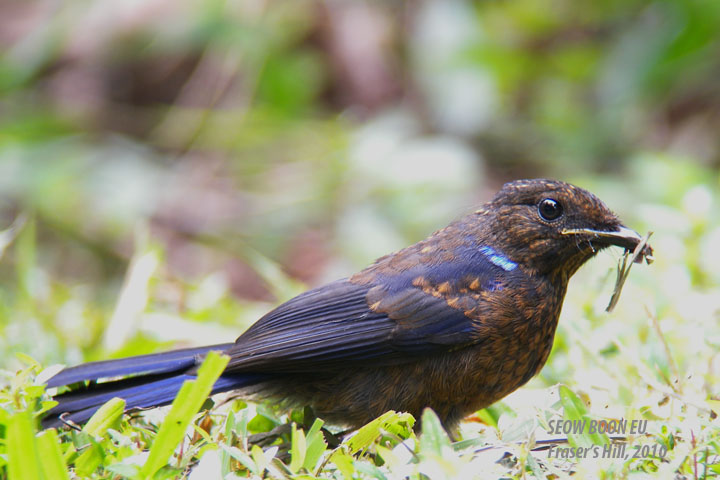
Large Niltava is one of the common birds in Fraser's Hill, you can easilly see it on every street or trail.
Adult Large Niltava, male in Blue and female in brown.

Juvenile Large Niltava

The common Corvidans in Fraser's Hill include the Grey-chined Minivet, Javan Cuckoo-Shrike, Lesser Racquet-tailed Drongo, Bronze Drongo, White-Throated Fantail, and Black & Crimson Oriole.

Grey-chined Minivet, male in orange color, and female in yellow.

Javan Cuckooshrike

Please be reminded, there is no Large Cuckooshrike recorded in Peninsular Malaysia. I realized that many have mistakenly named it as Large Cuckooshrike rather than Javan Cuckooshrike.

White-Throated Fantail

Lesser Racquet-tailed Drongo

Black and Crimson Oriole

Woodpeckers and Barbets are also highly vsible in Fraser's Hill, the most common Barbets are the Fire-tufted Barbet and Black-Browed Barbet.

Black-Browed Barbet

Fire-tufted Barbet

The most common Pigeons in Fraser's Hill are the Mountain Imperial Pigeon and the Little Cuckoo Dove. Other Green Pigeons can also be found in the forested area at the lower elevation.

Mountain Imperial Pigeon

Little Cuckoo Dove

Trogon, Broadbill and Pitta are not a common birds in Fraser's Hill, you may occasionally spot them in the forested area. Red-headed and Orange-breasted Trogon are the most visible trogon in Fraser's Hill, and I only spotted the Red-headed Trogon in this birding trip.

Red-headed Trogon

Long-tailed Broadbill and Silver-breasted Boardbill are the most visible broadbills in Fraser's Hill.
Long-tailed Broadbill

My lifers in this trip included the Long-tailed Broadbill, Black Laughingthrush, Ashy Bulbul and White-hooded Babbler.

Click HERE to find out more about birding in Fraser's Hill and Fraser's Hill International Bird Race.

Happy Birding, Digiscoping and Digisniping.

Tuesday, December 22, 2009

Birding in Singapore

You won't think that Singapore, home to the world class Changi airport, beautiful Marina Bay and water front with Singapore Flyer, the shopping paradise of Orchard Road and the world class recreation, entertainment resort of Sentosa Island and Formula One night race, that is also a good stop for bird watching.

This is due to the geographical location of Singapore in the East Asian-Australasian bird migration flyway and that is truly a very green garden city. Every year, during the Christmas season, thousands of migratory birds will visit or stop-by Singapore, some even spend their whole winter in the nature reserves, gardens and parks.

I visited Singapore during the Christmas season (8-14 Dec) not only for the world class entertainment, shopping, night life and museums. During the day, I bird watched in the following places and see what had I discovered:

Singapore Botanic Gardens. This garden is a Green Jewel of Singapore city, a must visit Botanic Gardens in South East Asia. The garden is just a walking distance from Orchard road. Check out this LINK to find out more about the garden.

I saw my four lifers in the garden, the Hooded Pitta (no picture), Orange-headed Thrush, Banded Woodpecker, and Green-naped Lorikeet (introduced species).
In fact, Singapore is one of the best place in this region to watch those introduced species of parots, parakeets and lorikeets.
I also have a very close distance view of Oriental Pied Hornbill (female),migratory Common Kingfisher,
A Blue-crowned Hanging Parrot, I learned that this bird is a vanishing species in Singapore:
Common Flameback,
Hill Myna,Javan Myna,

Pink-necked Green Pigeon and etc.
You can see that resident, introduced and migratory birds are living together in harmony in Singapore Botanic Gardens.

Sungei Buloh Wetland Reserve, It is a treasure of Singapore and a must visit place for migratory and wetland birds, a wetland reserve well managed with good facillities. It is one of the important area recognized for the East Asian-Australasia Flyway and a good place to learn more about waders.

I saw many waders and egrets there, and also managed to digiscope Pacific Golden Plover and White-collared Kingfisher, they are really beautiful and easily spotted.
A newly published book by NPark's Publication entitles "Migratory Birds of Sungei Buloh Wetland Reserve", it is a good guide book for those who are interested to visit this wetland reserve and to learn more about migratory birds in Singapore. Thanks to Meng Meng for given me the book, it is my best Christmas gift. Check out this LINK to find out more about the wetland reserve and the book.

Bukit Timah and Central Nature Reserve and Parks, it is located at the central catchment of Singapore, and is an important area for water catchment. The parks include the nature parks around the Central Catchment, Bukit Timah Nature Park and Bukit Batok Nature Park, and do not miss the HSBC Tree top Walk. Check out this LINK to find out more about the nature reserves.

This whole area is a good for spotting lowland rainforest and garden birds. I had my lifer of Straw-Headed Bulbul at the Hindedhe Nature Park, they are very melodious birds.Besides that, I also saw Crimson Sunbird, Asian Fairy Bluebirds, Dollarbirds, Blue-tailed Bee eaters, Emerald Dove, bluish Asian Glossy Starling, Greater Raquet-tail drongo, Chestnut-bellied Malkoha, Hill Mynah, Javan Myna, Yellow-vented Bulbul, Olive-backed Bulbul and Common Flameback Woodpecker, etc.
Pulau Ubin, the offshore island off the northeast coast of Singapore, this island is a good place for spotting wetland, shore and sea birds. I didn't visit this island but have seen it from the Changi Park, it is really a beautiful green offshore islands, and it is also known as the Island of Hornbill. I will visit the island in my next visit to Singapore. Check out this LINK to find out more about the island.

Guides to Birding in Singapore
Here are the recommended guide books about birding places in Singapore:
1. Birds, A Photographic Guide to the Birds of Peninsular Malaysia and Singapore, by M. Strange and A. Jeyarajasingam, was published in 1993, but still a good reference to find out birding places in Singapore.
2. An illustrated field guide of "Birds of South-East Asia", by Craig Robson.

Visit this LINK to find out more about birding in Singapore.

Thursday, December 17, 2009

Taiwan Endemic Subspecies

I spotted more than 20 endemic subspecies in Taiwan. The digiscoped pictures are as follows:

Crested Goshawk (Accipiter trivirgatus formosae), a resident in Taiwan, I spotted this raptor in Taipei Botanic Gardens, it is one of the beautiful raptors in Taiwan.
I spotted the Crested Serpent Eagle (Spilornis cheela hoya) on the way to Neidong from Wulai waterfall.

We heard the call of the eagles while walking on the road towards Neidong, not knowing which eagle is that, we then imitated their call to attract them out from the forest. Three raptors flew above us after some minutes, and one perched on the tree at the slope just in front of us. Unfortunately, the bird was blocked by branches and leaves, but it is good enough for us to identify the raptor as the Crested Serpent Eagle (Spilornis cheela hoya).

Oriental Turtle Dove, in Chinese is known as Golden-backed Dove. It is one of the common dove in Taiwan, easy to see in parks and gardens. I feel that this species of dove is very beautiful, it has a golden back which really attracts my attention.
Spotted Dove (Streptopelia chinensis formosana), this dove is as common as the Oriental Turtle Dove.

White-bellied Green Pigeon (
Treron sieboldii sororius), I saw it at the buddhist temple in Puli.


Chinese Bulbul, it is a common bulbul in Taiwan. It is as common as our Yellow-vented Bulbul.

Black Bulbul, I spotted
at the buddhist temple in Puli:

Winter Wren, spotted it in the early morning in Hehuanshan.


Plumbeous Water Redstart, I spotted both male and female in Alishan, the male 's territory is at the sister pond, and the female is at the river near to the Sacred Tree trail.

Tits are small, agile and active birds, their feeding behavior is fast as the sunbirds and flowerpeckers, but manily feed on insects. Digiscoping small birds is always a challenging task, but as long as the bird is perching, it is not impossible to digiscope them, just a matter of skill and practice.


Green-backed Tit from Alishan,

Taiwan Varied Tit from Wulai :

Coal Tit, from Alishan: This is the only Coal Tit picture that I have. The main purpose of this picture is to show you the distinct feature of Taiwan Coal Tit, it has distinct fine crest as compared to other subspecies of Coal Tit.
Vinaceous Rosefinch, I saw both male and female in Hehuanshan.

 Grey Treepie at Wulai:


Spotted Nutcracker, sighted at Tataka National Park.

Alpine Accentor, I saw it at the road side of the Hehuanshan National Park. The picture is not so sharp is due to the misty weather.

The endemic sub-species which I spotted but did'nt digiscope are the Grey-cheeked Fulvelta, Rufous-capped Babbler, Streak-breasted Scimitar Babbler.
hope you enjoy my digiscoped bird pictures from Taiwan.