Showing posts with label Kingfisher. Show all posts

Monday, June 10, 2013

A Pair of Common Kingfisher at Huben

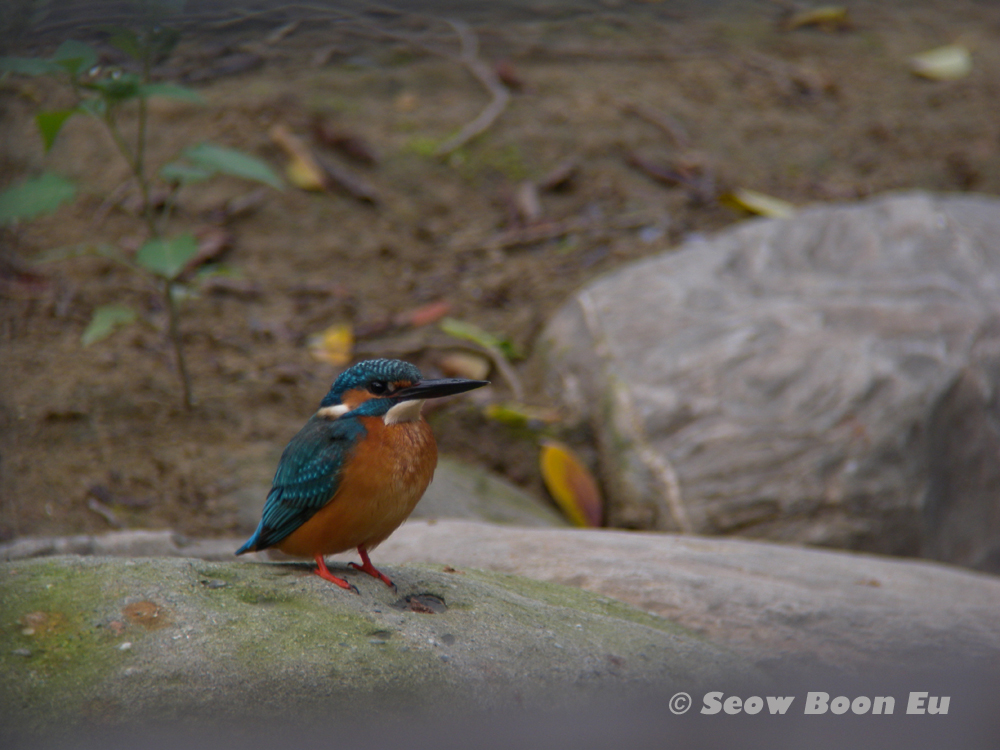
Sighted and digiscoped this pair of Common Kingfisher at Huben in Yulin County.

Do you know how to distinguish the male and the female?
""Click on this LINK to find out the answer""

click on the picture to enlarge
Happy Birding.

Common Kingfishers at NCKU


Today (4-15-2013), I spotted a pair of Common Kingfisher (Alcedo atthis 翠鳥) at NCKU (National Cheng Kung University) in Tainan, Taiwan. (click on the picture to enlarge)


A female Common Kingfisher with the reddish lower mandible.

A male Common Kingfisher with the dark lower mandible.


Happy Birding.

Monday, August 22, 2011

Blue-eared Kingfisher in Ipoh

I'm currently on vacation back to my hometown in Penang, Malaysia. I spent 6 days (14-19 Aug.) in Fraser's Hill and Ipoh, mainly for birding and food tasting. Bird watching in Fraser's Hill at this time was really quiet, not many active birds can be seen. Although without a lifer during this birding trip to Fraser's Hill, I still had some interesting birding experiences which I will update in my blog later.

In Ipoh, I saw a female Blue-eared Kingfisher (Alcedo meninting) hiding in the shed of a small tree on the bank of the pond at Kek Lok Toong region. The blue colour plumage of the Blue-eared Kingfisher is really attractive and magnificent.

Here is the digiscoped picture of the kingfisher, hope you also like it, especially the beauty of the blue plumage. (click on the picture for enlarged view):
A female Blue-eared Kingfisher 

Common Kingfisher (Alcedo atthis) is the most common kingfisher in Asia and Europe, in fact, it is an uncommon migratory bird in Malaysia. As compared to the Blue-eared Kingfisher, the Common Kingfisher has darker plumage and light blue on the back, whereas the Blue-eared Kingfisher has brilliant bluish plumage on the crown and the wings, and stunning light blue on the back.

A male Common Kingfisher, which I digiscoped in Singapore Botanic Gardens in 2009.

Question: Do you know how to distinguish the male and female of these Alcedo kingfishers?
Answer:  You can actually find out the answer from these two pictures.

Thursday, September 2, 2010

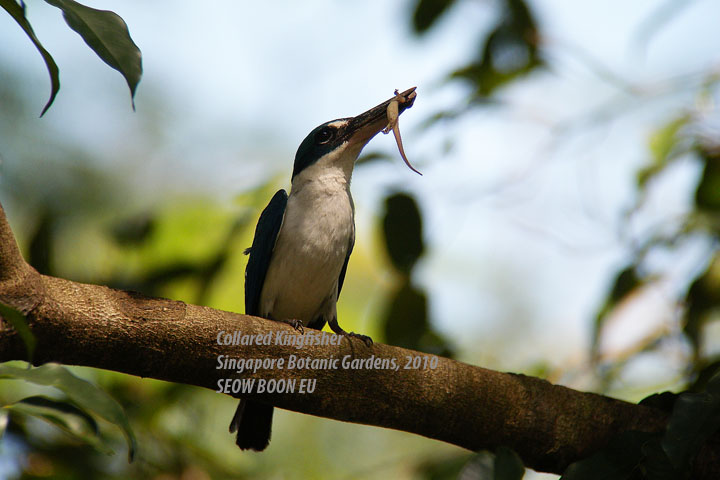
Collared Kingfisher at Singapore Botanic Garden

I visited the garden on 27 August 2010, and it's a raining day. Therefore, not many birds I spotted in this visit, whereas it was still early for migratory birds sighting.

The only interesting bird I spotted was the Collared Kingfisher carrying a gecko in its beak, an indicator of successful nesting or fledging in the garden.


Visit my previous BLOG if you are interested to find out more about birding in Singapore Botanic Gardens.

Happy Birding.

Wednesday, May 26, 2010

Kingfisher and its allies in Sepilok, Sabah.

I spotted seven species of Kingfisher and its allies (Blue-throated Bee-eater and the Dollarbird) in Sepilok. The kingfishers that I spotted were the Rufous-collared Kingfisher, White-collared Kingfisher, Ruddy Kingfisher, Blue-eared Kingfisher, Stork-billed Kingfisher, Banded Kingfisher and Oriental Dwarf Kingfisher.

Rufous-collared Kingfisher, I spotted both male and female, and also the juvenile, but didn't able to digiscope the female. I noticed that the male was the one responsible to take care and feed the juvenile, the male would always trying to attract my attention. I found the juvenile always like to hide in the bush, stay alert and quiet.

Adult male (back view, front view and side view):
Juvenile Rufous-collared Kingfisher:

Oriental Dwarf Kingfisher (Black-backed Kingfisher, Ceyx erithacus)is the most common kingfisher at the Kingfisher Trail in Sepilok, if you are lucky, you can spot it at the natural bird bath and the man-made pond.

Oriental Dwarf Kingfisher with side view, front view and back view:

Banded Kingfisher is rare and most quiet kingfisher, I was lucky to spot this female Banded Kingfisher at the Kingfisher Trail.

In Sepilok, Blue-eared Kingfisher and Ruddy Kingfisher are the most difficult to spot and digiscope. Blue-eared is small in size, prefers shady places, and very alert, I therefore have to stay far from the kingfisher and decide the right combination of shuttle speed and aperture to be used to digiscope the Kingfisher. Ruddy Kingfisher is a shy bird, I saw the kingfisher flew across the trail once but did not manage to digiscope it.

Blue-eared Kingfisher:

White-collared Kingfisher is the most noisy kingfisher, and it is very common at the Sepilok B&B:

Stork-billed Kingfisher, one of the common kingfishers, can be seen at the lake in Sepilok RDC:


Kingfisher's allies, the Blue-throated Bee-eater, the only Bee-eater I spotted in Sepilok at the Kingfisher Trail.

Adult Blue-throated Bee-eater:

Juvenile Blue-throated Bee-eater:

The Dollarbird, one of the common birds in Sepilok RDC.


Click HERE if you would like to go back to the main blog of Birding in Sandakan, Sabah.

Saturday, March 20, 2010

Black-crowned Night Heron, Penang.

On Friday, I received a message in my blog regarding the sighting of the Malayan Night Heron in USM. I was excited and wish that I could see the "Malaysian" Night Heron in Malaysia for the first time. I went to search the bird on Saturday afternoon, but disappointedly, I couldn't find the bird.

Why the Malayan Night Heron is hard to spot in Malaysia? whereas, it is very common in Taiwan. Check out my blog about Taiwan's Malayan Night Heron and a juvenile spotted in Singapore Botanic Gardens.

However, I spotted a pair of adult and a juvenile Black-crowned Night Heron (Nycticorax nycticorax) in USM, they are the most common Night Heron in East Asia. Let's take a look of the Black-crowned Night Heron that I spotted:

A beautiful adult with the bluish lore, matured bird:
Immature with the yellowish lore:
Let's take a closer look of their crown, three white extended feathers from the crown. It is a beautiful hair style, isn't it?:
A juvenile with different plumage, brown with white streaks:

These are the Black-crowned Night Herons I spotted in Taiwan in 2009. In Taiwan, the bird is the most common Night Heron and it is called as Heiguan Yelu 黑冠夜鹭.

An adult in Taiwan, with yellowish lore:
A juvenile in Taiwan:

Hope that the readers will gain some knowledge on the identification of the Black-crowned Night Heron through the pictures on this blog. Last but not least, here are the beauties of the day, a Stork-billed Kingfisher and a Common Kingfisher:
I noticed that this is the reaction of the Common Kingfisher when the raptor flew above it.
danger! raptor! hide... visit again my blog again for the next posting.

Happy Birding and Digiscoping.


Saturday, March 13, 2010

Ten Asian Openbills, Penang.

Today, I'm free from work and decided to go for birding to find out about the Openbills and other migratory birds in the Seberang Perai Tengah areas.

Asian Openbill (or Asian Openbill Stork, Anastomus oscitans) is the latest waterbirds wanted by most birders in Penang, it was first recorded in Penang about weeks ago. Today, I spotted 10 Asian Openbills soaring above the paddy field, and roosting on the trees in between the paddy field in Permatang Nibong.
Here are some of the pictures of Asian Openbills. Look at the bill carefully, you will know why it is called as Openbill.

How many adult and juvenile birds were there? It is hard to observe and give an exact number in a day, because the birds are very sensitive to human. From my record and observation, I believe most are non-breeding adult, some have the pinkish leg, some don't, and all have space in between the mandibles.

Here are the pictures of the openbills sighted roosting on the trees, all are adult birds.

This could be an immature openbill, it has a brownish bill, brownish-gray plumage on the head, neck and scapulars.
I can't tell the exact number of adult and juvenile, all birds have developed a perfect space in between the mandibles, only the colour of the bill and plumage can be used to distinguish them. I would say, there were more non-breeding adult birds than juvenile. I could be wrong. Let me know if my identification for Openbill was incorrect.

My another lifer, the dark morph Pacific Reef Egret at Teluk Air Tawar, a place near to the former RAAF airbase.

Here are the beautiful birds of the day, which I spotted during my visit to Teluk Air Tawar and Permatang Nibong.


Happy Birding and Digiscoping.


Thursday, January 21, 2010

Migratory Birds of Singapore Botanic Gardens

Singapore Botanic Gardens (SBG) is one of my favourite birding sites in Singapore. During my last week's visit (14-20 Jan), I spotted many migratory birds in the garden, included the Hooded Pitta, Orange-headed Thrush, Malayan Night Heron, Tiger Shrike, Common Kingfisher, Blue-tailed Bee-eater and Red-legged Crake.

The most fascinating migratory birds I spotted in the garden were the Hooded Pitta and Orange-headed Thrush. In my last visit in December, I managed to digiscope the Orange-headed Thrush, but sadly, the pictures were spoilt by the excessive flashes used by the paparazzi. The thrush in my digiscoped pictures became a "Halo-ed Thrush".

This time, the paparazzi were gone, but both birds were still there together with a new migratory bird, the juvenile Malayan Night Heron.

The Hooded Pitta has very distinctive multicolours, with black, white, brown, green, red, blue and yellow. It has very close similar plumage colour as compared to the Fairy, Mangrove and Blue-winged Pitta, with the distinguishable blackish face, brownish cap and greenish chest and belly.

Let me share with you the colourful Hooded Pitta through my digiscoped pictures.


These pictures are my first digiscoped Pitta, they were digiscoped in the shady place without using any artificial flash light, but with the moderate ISO level, lower shuttle speed and taken from a distance with minimum disturbance to the bird. So, if possible, please leave your flash gun at home.

I saw two Orange-headed Thrushes in the garden. It was a wonderful moment for me to observe their distinctive behavior of taking their evening bath. Here are their pictures, but I couldn't distinguish which is male, which is female? If you can, please tell me by leaving your comment here.

The first thrush:
The second thrush:

This species of thrush has the similar daily bathing behavior as the Blue Whistling Thrush in Kek Lok Toong, Ipoh, I noticed that both species prefer taking bath in the free running water, eg. waterfall. Thrushes could be one of the cleanest birds on earth based on my observations of their distinctive daily bathing behavior.

Orange-headed Thrush taking its evening bath (courtesy of Khng Eu Meng):

The Malayan Night Heron that I spotted in the garden was the juvenile, it has very different plumage as compared to the adult, it is grayish in colour. The adult can be viewed in my earlier blog about the Taiwan's Malayan Night Heron, CLICK HERE to view, you will then be able to distinguish the differences between the adult and the juvenile .
The Tiger Shrike that I spotted in the SBG was a juvenile bird as well. I wonder why there were more juvenile migratory birds that I spotted in the SBG, could it be the juvenile cannot compete with the adult birds for their feeding ground and were pushed further south to Singapore.

front view:
side view:
and back view:
Another beautiful migratory bird I spotted in SBG was the Red-legged Crake, it was my lifer, unfortunately I missed the chance to digiscope it, but thank to Meng Meng for his fast reaction to record this bird, here is the picture (courtesy of Khng Eu Meng):
I spotted both the Common Kingfisher and Blue-tailed Bee-eaters in the SBG during my last visit in December, and they were still there in the garden after a month. Here are the pictures I took in my recent visit to the garden.
I had a wonderful and memorable visit to the Singapore Botanic Gardens, this garden has provided me many precious moments to observe and digiscope the migratory lowland birds, especially the Hooded Pitta and Orange-headed Thrush. I learned that a well planned and well managed Botanic Garden can serve as an important shelter to many avifauna, not only to the resident species, but also the migratory ones. Well done to Singapore Botanic Gardens.

Check out my previous BLOG about Birding in Singapore.

Special thank to Meng Meng for taking me to this wonderful birding place in the city of Singapore.